


Strategic Insight
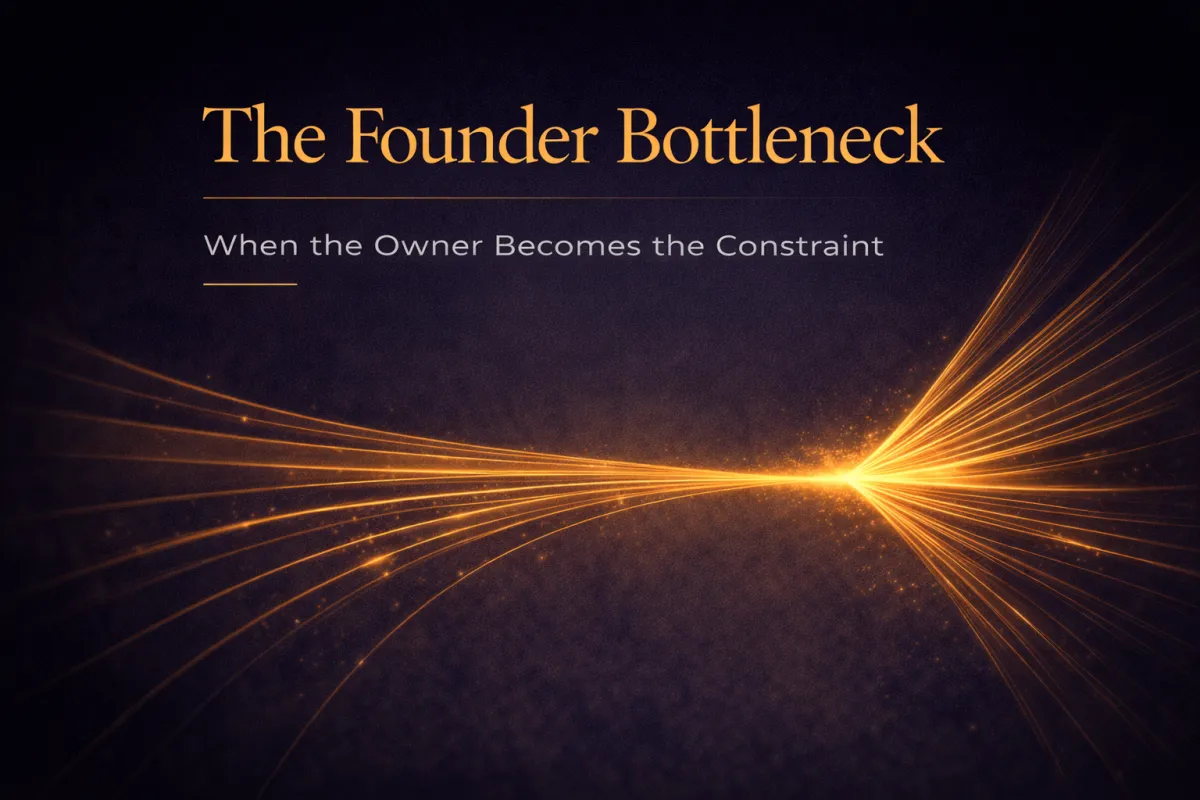
THE FOUNDER BOTTLENECK
Growth slows when too many decisions remain concentrated around the founder.
Opening Insight
Many founder-led companies eventually encounter a paradox.
The very person who built the business gradually becomes the factor that limits its growth.
In the early stages of a company, the founder’s involvement drives progress.
The founder sells.
The founder solves problems.
The founder makes the most important decisions.
Energy, speed, and personal judgment propel the organization forward.
This dynamic is natural in the formative years of a business.
In fact, it is often the reason the company exists at all.
Yet as the company grows, a quieter structural dynamic begins to emerge.
Decisions increasingly flow through the founder.
Customers rely on the founder’s presence.
Employees depend on the founder to resolve complex issues.
Over time, the organization’s momentum becomes tied to a single individual.
The founder does not intend to create this dependency.
It emerges gradually through the normal process of growth.
What began as leadership slowly becomes structural reliance.
At a certain scale, the founder becomes the central operating system of the business.
And when that occurs, the company’s future becomes constrained by the founder’s capacity.
The Founder as the Early Engine
In the early stages of a company, founder involvement is not only expected.
It is often essential.
Most young businesses begin with limited structure.
Processes are informal.
Roles are fluid.
Decisions are made quickly and directly.
The founder fills the gaps where structure does not yet exist.
They sell when sales systems are still forming.
They negotiate when relationships must be built personally.
They solve operational problems when teams are still learning how to work together.
The founder becomes the connective tissue that holds the company together.
Customers trust the founder’s credibility.
Employees rely on the founder’s judgment.
Suppliers and partners recognize the founder as the central authority.
At this stage, the founder’s presence accelerates the organization.
Decisions are made quickly.
Opportunities are pursued immediately.
The company moves with the speed of a single decision-maker.
For an emerging business, this concentration of authority can be a powerful advantage.
The founder’s energy becomes the engine of growth.
How Dependency Quietly Forms
As the company expands, the founder’s central role often becomes reinforced rather than replaced.
Employees learn that the fastest path to resolution is through the founder.
Customers discover that the founder can approve exceptions.
Key decisions increasingly escalate upward.
The organization adapts around the founder’s availability.
What begins as convenience gradually becomes habit.
Habit slowly becomes structure.
Employees begin routing complex decisions toward the founder.
Salespeople rely on the founder to close important deals.
Managers defer difficult operational calls upward.
Customers ask for the founder by name.
None of these behaviors appear problematic in isolation.
Each interaction seems reasonable.
Each decision appears efficient.
Yet together they form a pattern.
Over time, the organization learns that the founder is the final authority on nearly everything.
The business becomes designed around that assumption.
The founder becomes the invisible hub through which the organization operates.
This shift rarely occurs intentionally.
It simply emerges through repeated behavior.
The system adapts to the founder’s presence rather than developing structural independence.
The Operational Gravity of Growth
As companies scale, the complexity of the organization increases.
More customers create more relationships.
More employees introduce more coordination challenges.
More revenue streams create more operational variables.
Every layer of growth produces additional decisions.
A company that once made dozens of decisions each week may soon face hundreds.
Eventually, thousands.
If those decisions continue to flow through the founder, the system begins to slow.
Human attention has limits.
No individual can absorb an unlimited volume of information.
No founder, regardless of talent, can process every operational decision inside a growing organization.
The mathematics of growth eventually collide with the limits of human capacity.
The founder may work longer hours.
They may attempt to respond faster.
They may push themselves harder.
Yet the structural reality remains unchanged.
The organization’s decision velocity remains constrained by a single individual.
Growth introduces operational gravity.
Every new layer of complexity increases the weight placed on the founder’s attention.
Eventually the founder’s time becomes the scarcest resource in the company.
When the Founder Becomes the Bottleneck
At a certain point, the organization begins to feel the effects of this concentration.
Decisions take longer.
Teams hesitate while waiting for direction.
Customers wait for approvals that require the founder’s involvement.
Opportunities move more slowly than the market demands.
From the outside, the company may appear healthy.
Revenue may still be growing.
The team may be expanding.
Yet inside the organization, a quieter constraint begins to shape daily operations.
The pace of the business becomes tied to the founder’s availability.
If the founder is traveling, decisions pause.
If the founder is overwhelmed, projects slow.
If the founder steps away, momentum fades.
The organization has unknowingly built itself around a single point of control.
This moment is often deeply frustrating for founders.
They feel busier than ever.
Their calendar is filled with meetings and decisions.
Yet the company does not seem to move faster.
In some cases, growth even begins to stall.
What once accelerated the company now limits it.
The founder has become the bottleneck inside the system they created.
Why Delegation Alone Does Not Solve It
Many founders respond to this moment by attempting to delegate more aggressively.
They push decisions downward.
They ask leaders to take greater ownership.
They encourage the organization to operate independently.
Delegation is important.
But delegation alone rarely resolves the structural issue.
The organization has already learned to rely on the founder.
Decision authority may exist on paper.
Yet the underlying architecture of the company still routes complexity upward.
Employees remain uncertain about boundaries.
Customers continue to expect founder involvement.
Important relationships still reside with the founder personally.
Without structural redesign, delegated authority often flows back toward the founder when pressure rises.
Managers escalate difficult issues.
Sales teams request approval for unusual deals.
Operational problems return to the founder’s desk.
The founder may attempt to step back.
Yet the system quietly pulls them back into the center.
This is not a failure of discipline.
It is a failure of architecture.
The company has never been designed to operate without the founder as its central node.
Designing a Company That Can Operate Without the Founder
A structurally independent company does not remove the founder’s influence.
Instead, it removes the founder’s necessity from daily operations.
The organization develops decision structures that allow teams to operate within clear boundaries.
Customer relationships become institutional rather than personal.
Operational systems define how work moves through the company.
Leadership roles carry real authority rather than borrowed authority.
The company transitions from founder-powered to structure-powered.
This transition does not diminish the founder’s importance.
In many cases, it elevates it.
When the founder is no longer required to resolve every operational issue, their attention can shift toward higher-leverage decisions.
Strategy.
Long-term positioning.
New market opportunities.
Capital allocation.
Partnerships and acquisitions.
The founder moves from operator to architect.
Instead of personally solving every problem, they design the structure that solves problems consistently.
This shift represents one of the most important transitions in the life of a company.
Businesses that achieve structural independence can scale beyond the founder’s personal capacity.
They can grow without requiring constant founder intervention.
They can operate predictably even when the founder is absent.
And importantly, they become transferable.
Buyers do not purchase businesses that collapse when the founder leaves.
They purchase organizations that function independently of any single individual.
Structural independence is therefore not only an operational advantage.
It is also a prerequisite for enterprise value.
Strategic Reflection
Many founders believe the greatest risk inside their company is external competition.
Market conditions.
Economic cycles.
Technological change.
Yet for many businesses, the most significant structural constraint exists internally.
The organization has quietly become dependent on the founder’s presence.
The question is not whether the founder works hard enough.
Most founders work harder than anyone else in the company.
The deeper question is structural.
Where does the organization rely on the founder to function?
Which decisions require the founder’s approval?
Which customer relationships depend on the founder personally?
Which operational problems ultimately flow back to the founder?
These patterns often reveal the underlying architecture of the business.
Companies that remain founder-dependent eventually encounter limits to scale.
Companies that transition toward structural independence gain the ability to grow beyond those limits.
The Profit Architecture Framework exists to design businesses that operate through structure rather than individual effort.
Businesses built on structure produce durable profit.
They scale more predictably.
And they create enterprise value that can exist beyond the founder’s presence.
Schedule a 15-Minute Strategy Conversation.
A focused 15-minute discussion exploring the structural architecture of your business and the opportunities it may contain.
Beard Wise Consulting works with founder-led companies to design durable profit, scalable revenue, and transferable enterprise value.
Executive Overview of the Framework
If you would like a concise overview of the structural drivers behind the Profit Architecture framework, you may request the Executive Briefing.
The briefing outlines the 12 Core Profit Drivers used to evaluate structural profitability, scalability, and enterprise value.
Copyright © 2026 Beard Wise Consulting, LLC. All rights reserved
DISCLAIMER
The information contained on this website and the resources available for download through this website is not intended as, and shall not be understood or construed as, professional advice. While the employees and/or owners of the Company are professionals and the information provided on this Website relates to issues within the Company’s area of professionalism, the information contained on this Website is not a substitute for advice from a professional who is aware of the facts and circumstances of your individual situation. Nothing on this site, nor advice from our experts, shall constitute legal advice.