



Founder-Led Exit Insight
BUILT TO SELL vs BUILT TO OPERATE
Businesses designed for daily operation are not always designed for transfer.
Opening Insight
Many founders assume that a profitable business will naturally be attractive to buyers.
If the company produces consistent revenue, employs a capable team, and serves loyal customers, it appears reasonable to assume that the business itself holds transferable value.
From the founder’s perspective, the logic seems straightforward.
If the company works today, another owner should be able to continue operating it tomorrow.
Yet when founders eventually begin exploring a potential sale, many encounter a surprising reality.
Businesses that operate successfully under a founder are not always easy to transfer to a new owner.
In some cases, the business that appears stable from the inside reveals structural dependencies that create uncertainty for potential buyers.
Revenue may be strong.
Clients may be satisfied.
The company may have operated successfully for years.
But the underlying structure of the business may still rely heavily on the continued involvement of the founder.
When buyers evaluate the company, this dependency changes how the business is perceived.
The issue is not whether the company can operate today.
The question buyers ask is whether the company can operate tomorrow without the founder who built it.
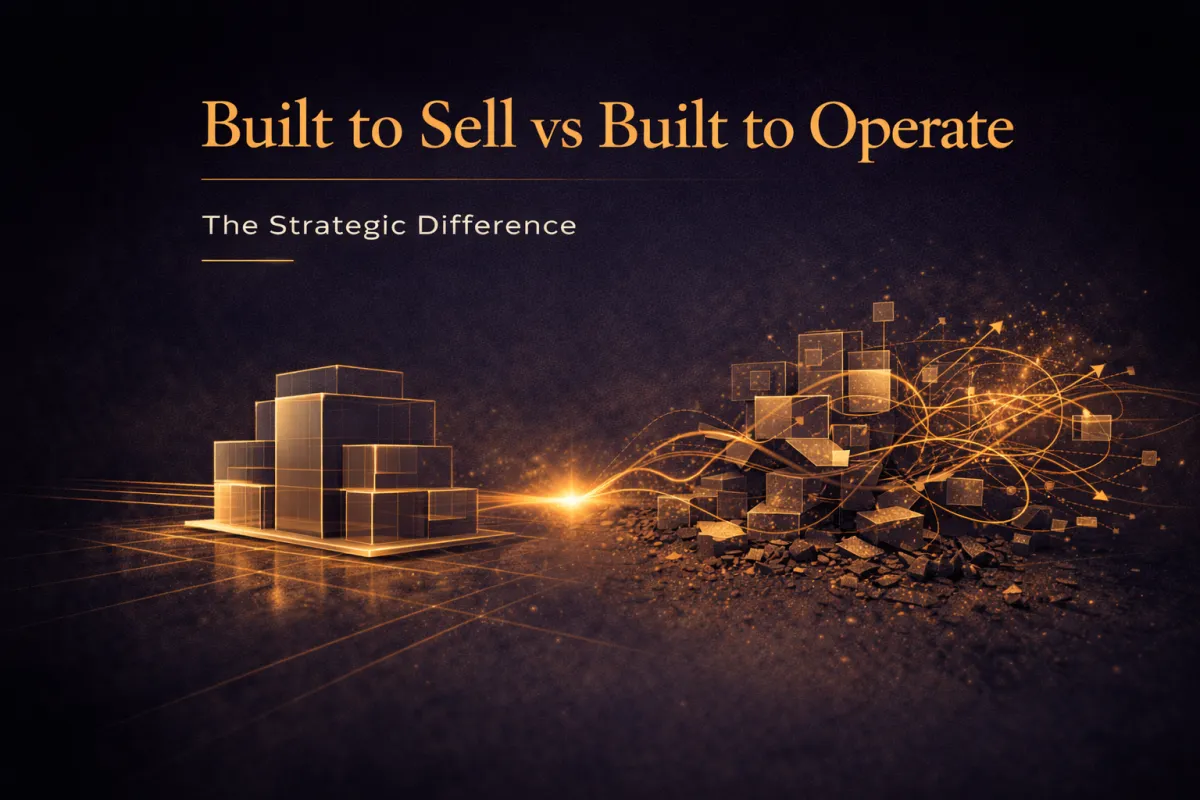
This distinction separates businesses that are built to operate from those that are built to transfer.
The Founder-Operated Business
Many founder-led companies begin with a highly personal operating model.
The founder drives the early growth of the business.
They win the first customers.
They shape the service offering.
They build the initial team.
They make the key strategic decisions.
This model is not inherently flawed.
In fact, founder-driven companies often outperform in their early years precisely because of the founder’s energy, judgment, and close involvement.
Decisions move quickly.
Customer relationships are strong.
The founder maintains direct awareness of operational details.
The company evolves through the founder’s experience and intuition.
For many businesses, this founder-centered model remains effective for years.
Revenue grows.
The team expands.
The company establishes a reputation in its market.
From the outside, the business appears stable and successful.
Yet beneath that success, the operating structure may remain heavily concentrated around the founder.
The founder may still approve important decisions.
The founder may maintain key client relationships.
The founder may resolve operational challenges.
The founder may coordinate departments and manage priorities across the organization.
The business functions effectively.
But it functions through the continued presence of the founder.
Why Founder Dependence Limits Transferability
When founders operate their companies day to day, these dependencies can feel natural.
They have built the company.
They understand the business better than anyone else.
Their involvement often feels like an advantage rather than a risk.
Buyers evaluate this structure very differently.
From the perspective of an acquirer, founder dependence introduces uncertainty.
The buyer must ask a simple question.
What happens when the founder is no longer involved?
If major client relationships depend on the founder, revenue stability becomes uncertain.
If key operational knowledge resides primarily with the founder, continuity becomes unclear.
If important decisions require the founder’s judgment, leadership capability may appear fragile.
None of these concerns necessarily mean the business cannot continue.
But each one increases the perceived risk of ownership transition.
Buyers evaluate risk carefully.
The greater the perceived dependence on the founder, the greater the uncertainty surrounding the future performance of the company.
This uncertainty directly affects valuation.
Even highly profitable companies may receive lower offers if buyers believe the business cannot operate independently.
In extreme cases, founder dependency can make the business difficult to sell at all.
The business itself may work well.
But its structure may not yet be designed to transfer.
How Buyers Evaluate Businesses
When buyers assess a company, they evaluate the business through a structural lens.
They are not simply purchasing past performance.
They are purchasing the future ability of the company to produce reliable economic outcomes.
Several structural factors influence this evaluation.
Operational systems are one of the first areas buyers examine.
Well-documented processes and repeatable workflows indicate that the business operates through systems rather than individual memory.
Leadership structure is another important factor.
Buyers look for management capability within the organization that can guide the company without constant founder involvement.
Revenue stability also matters.
Recurring revenue models, long-term contracts, and diversified customer bases increase buyer confidence in future cash flow.
Decision-making independence is equally important.
If the organization relies on the founder for daily problem solving or strategic direction, the company appears less stable from a buyer’s perspective.
Finally, buyers evaluate the scalability of the business model.
Businesses with clear operating systems and repeatable economics appear more transferable than businesses that depend on the founder’s personal expertise.
Taken together, these factors reveal something deeper than short-term performance.
They reveal the architecture of the company itself.
The Structural Difference Between Operating and Transferable Businesses
A company built to operate can function effectively for many years.
It can produce revenue.
Serve customers.
Support employees.
And provide meaningful income for its founder.
But operating success alone does not guarantee transferability.
Transferable businesses share a different structural characteristic.
They are designed to function independently of any single individual.
Key relationships are distributed across the organization rather than concentrated in the founder.
Operational knowledge exists within systems rather than inside a single person’s experience.
Leadership capability exists beyond the founder.
Decision authority is structured across the organization.
When these elements are present, the company becomes structurally durable.
The business no longer depends on the founder’s continuous involvement.
Instead, it operates through its architecture.
This is the condition buyers seek when evaluating an acquisition opportunity.
They are not purchasing the founder.
They are purchasing the system that produces the company’s results.
Why Exit Preparation Begins Years Before a Sale
Many founders begin thinking about selling their business only when the moment for transition approaches.
They begin speaking with advisors.
They consider valuation expectations.
They explore potential buyers.
Yet by the time these conversations begin, much of the structural design of the company is already set.
Transferable businesses are rarely created quickly.
They emerge through years of intentional structural design.
Leadership teams develop gradually.
Operational systems mature over time.
Customer relationships expand beyond the founder.
Decision-making authority becomes distributed.
These developments cannot be rushed.
They reflect the evolution of the company’s architecture.
When founders begin thinking about transferability earlier in the life of the business, they gain the ability to shape this architecture deliberately.
The result is often a company that is both easier to operate and more attractive to future buyers.
In this sense, exit preparation is not a late-stage event.
It is a structural design process that unfolds across the life of the company.
Profit Architecture and Transferable Business Design
The Profit Architecture Framework was developed to address exactly this structural challenge.
Many founder-led companies grow successfully through activity.
They win customers.
Expand teams.
Launch initiatives.
Yet the underlying design of the business often remains accidental.
Profit Architecture focuses on intentionally designing the structure of the company itself.
The methodology examines the systems that produce revenue.
The operating structure that governs decisions.
The economic model that generates profit.
And the leadership architecture that enables the business to function independently.
When these elements are intentionally designed, the business begins to produce outcomes that extend beyond the founder’s personal involvement.
Profit becomes more durable.
Revenue becomes more scalable.
And the company becomes structurally capable of transferring ownership.
Transferable enterprise value is not an accidental outcome.
It is the result of architecture.
Strategic Reflection
Many founders have built successful companies through years of hard work, creativity, and perseverance.
The business may provide meaningful income.
It may support a capable team.
It may serve customers exceptionally well.
Yet an important structural question often remains unexamined.
Could the business operate successfully without the founder’s daily involvement?
If the founder stepped away from the company, would the organization continue functioning smoothly.
Would customer relationships remain stable.
Would decisions continue to be made effectively.
Would the company’s results remain consistent.
These questions reveal something deeper than operational performance.
They reveal the architecture of the business itself.
Understanding this architecture is often the first step in preparing a company not only to operate successfully, but to eventually transfer ownership.
Schedule a 15-Minute Strategy Conversation.
A focused 15-minute discussion exploring the structural architecture of your business and the opportunities it may contain.
Beard Wise Consulting works with founder-led companies to design durable profit, scalable revenue, and transferable enterprise value.
Executive Overview of the Framework
If you would like a concise overview of the structural drivers behind the Profit Architecture framework, you may request the Executive Briefing.
The briefing outlines the 12 Core Profit Drivers used to evaluate structural profitability, scalability, and enterprise value.
Copyright © 2026 Beard Wise Consulting, LLC. All rights reserved
DISCLAIMER
The information contained on this website and the resources available for download through this website is not intended as, and shall not be understood or construed as, professional advice. While the employees and/or owners of the Company are professionals and the information provided on this Website relates to issues within the Company’s area of professionalism, the information contained on this Website is not a substitute for advice from a professional who is aware of the facts and circumstances of your individual situation. Nothing on this site, nor advice from our experts, shall constitute legal advice.