



Recent Thinking Insight
The Quiet Cost of Founder Dependence
Many founder-led companies reach meaningful scale while remaining structurally dependent on the founder for key decisions, coordination, and problem solving. This essay explores how founder dependence quietly limits scalability and enterprise value, and why intentionally designing the architecture of the business is essential for building a company that can truly operate and grow beyond the founder.
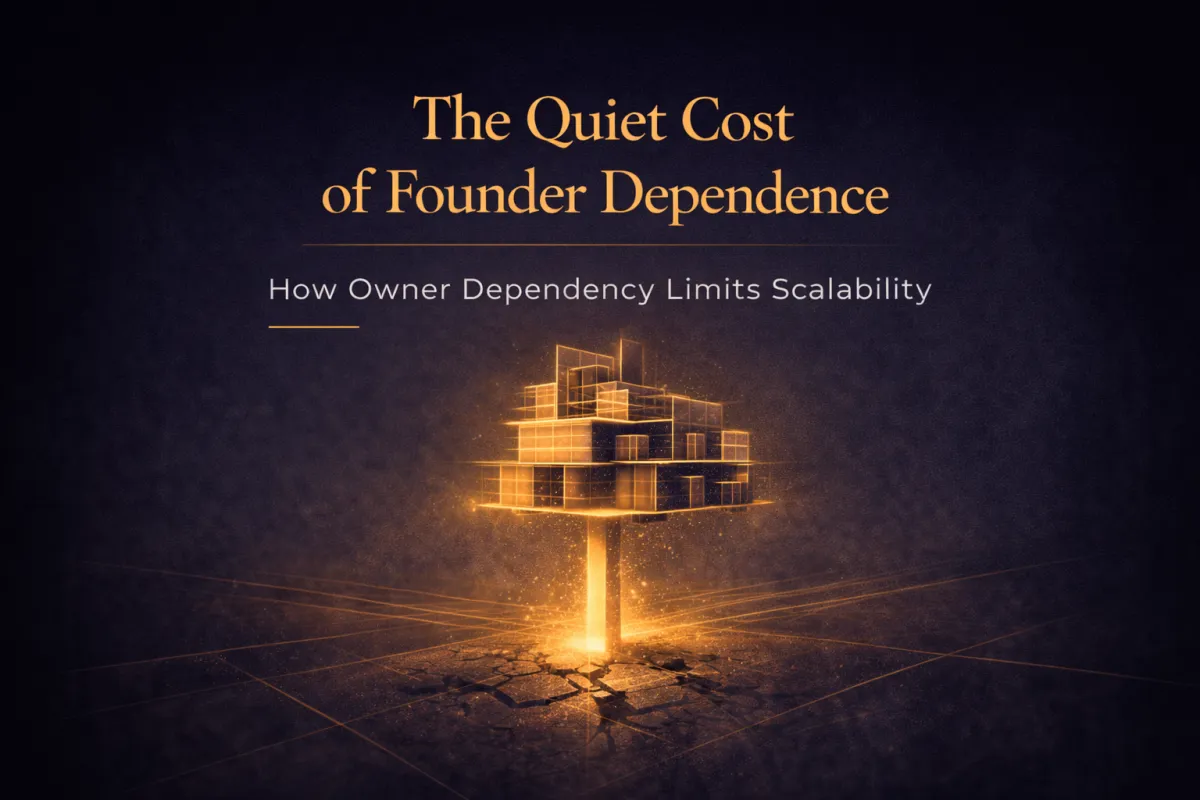
The Quiet Cost of Founder Dependence
Many founder-led companies reach meaningful scale while remaining structurally dependent on the founder.
The business grows.
Revenue increases.
The team expands.
From the outside, the company appears successful and stable.
Yet inside the organization, an invisible pattern often begins to form.
Decisions flow toward the founder.
Problems accumulate around the founder.
Coordination increasingly requires the founder’s presence.
The company functions, but it does not truly operate independently.
This condition is rarely intentional.
Most founders never set out to build a company that depends on them.
The pattern emerges gradually as the business grows through activity rather than through deliberate structural design.
In the early stages of a company, founder dependence is natural and often beneficial.
The founder possesses the deepest understanding of the market.
They carry the original vision for the company.
They make rapid decisions that allow the business to move quickly.
In this phase, founder involvement accelerates progress.
But as the company scales, the same dynamic that once created speed begins to introduce friction.
More decisions require coordination.
More people require clarity.
More systems must operate consistently across the organization.
When the underlying architecture of the company has not been intentionally designed, the founder quietly becomes the operating system of the business.
Information flows through them.
Authority concentrates around them.
Critical decisions depend on their constant involvement.
At first, this pattern may not appear problematic.
The company continues to generate revenue.
Customers are served.
The team works hard to maintain momentum.
But the structural implications slowly compound.
Decision velocity begins to slow.
Operational complexity increases.
The founder’s time becomes the primary constraint on the company’s growth.
What appears to be a leadership challenge is often a structural one.
The business has grown in size, but its architecture has not evolved to distribute responsibility, authority, and capability throughout the organization.
Without this distribution, the founder remains the central point of coordination.
The result is a company that grows in scale while remaining structurally small.
Many founders attempt to solve this challenge by working harder or by attempting to remove themselves from day-to-day operations.
Neither approach addresses the underlying issue.
Scalable companies are not created by eliminating founder influence.
They are created by designing a structure that allows the business to function without constant founder intervention.
This distinction is central to the principles of Profit Architecture.
Businesses do not ultimately scale through effort alone.
They scale through the structure that governs how decisions are made, how work flows through the organization, and how responsibility is distributed across the system.
When The Profit Architecture Framework is implemented, the company begins to operate differently.
Decisions move closer to the point of execution.
Teams gain clarity around authority and responsibility.
Operations become more consistent and less dependent on the founder’s direct oversight.
The founder’s role evolves from operational coordinator to architectural designer of the business itself.
This transition often marks an important inflection point in the life of a company.
The business begins to move from founder-powered growth to structurally enabled growth.
Momentum is no longer sustained through the founder’s personal involvement in every critical function.
Instead, it emerges from the design of the organization itself.
This is not about stepping away from the business.
It is about building a company capable of standing on its own.
Schedule a 15-Minute Strategy Conversation.
A focused 15-minute discussion exploring the structural architecture of your business and the opportunities it may contain.
Beard Wise Consulting works with founder-led companies to design durable profit, scalable revenue, and transferable enterprise value.
Executive Overview of the Framework
If you would like a concise overview of the structural drivers behind the Profit Architecture framework, you may request the Executive Briefing.
The briefing outlines the 12 Core Profit Drivers used to evaluate structural profitability, scalability, and enterprise value.
Copyright © 2026 Beard Wise Consulting, LLC. All rights reserved
DISCLAIMER
The information contained on this website and the resources available for download through this website is not intended as, and shall not be understood or construed as, professional advice. While the employees and/or owners of the Company are professionals and the information provided on this Website relates to issues within the Company’s area of professionalism, the information contained on this Website is not a substitute for advice from a professional who is aware of the facts and circumstances of your individual situation. Nothing on this site, nor advice from our experts, shall constitute legal advice.