



Profit Architecture Insight
ACTIVITY vs ARCHITECTURE
Scalable businesses are built through architecture, not activity.
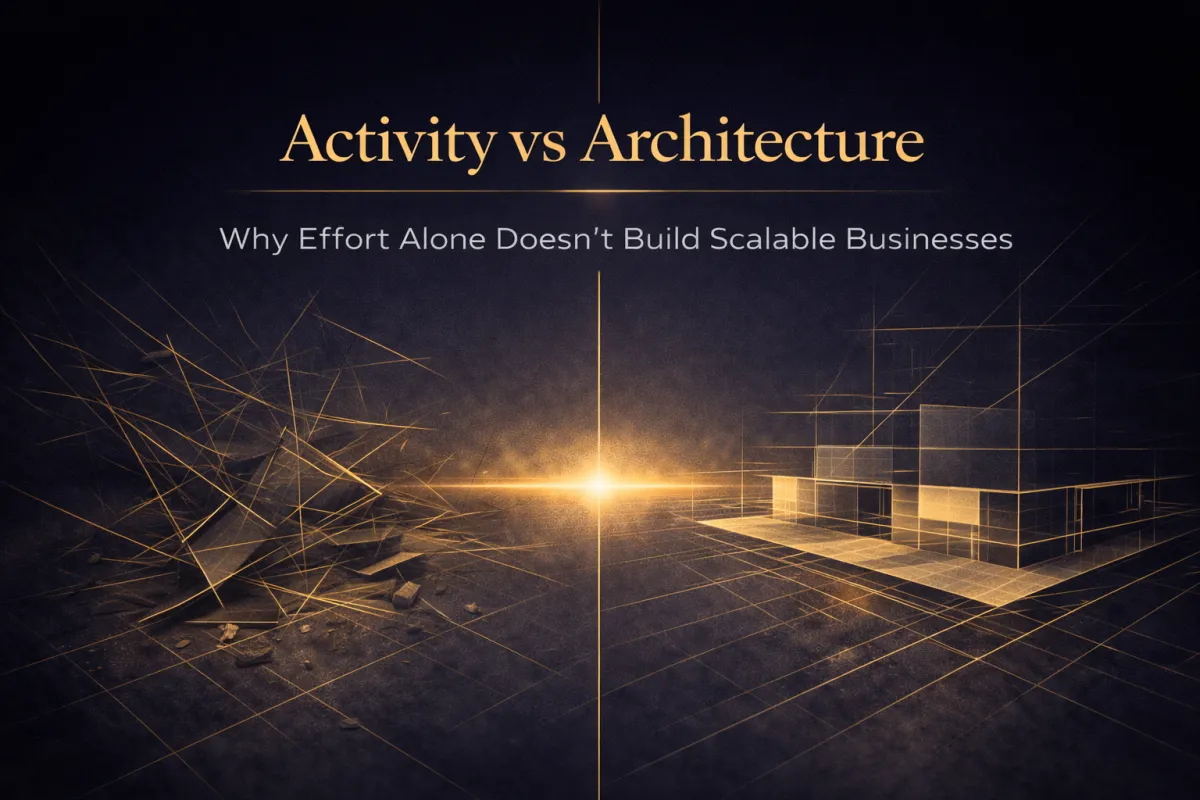
Most businesses grow through activity.
More marketing campaigns.
More sales effort.
More hiring.
More initiatives designed to drive growth.
In the early stages of a company, this approach often works. Effort produces revenue. Revenue produces momentum. The company grows.
Yet as the business scales, many founders begin to notice a pattern that is harder to explain.
Despite increasing activity, the underlying results become less predictable.
Margins tighten.
Operations grow more complex.
Decisions increasingly depend on the founder.
Growth becomes harder to sustain.
From the outside, the company appears successful. Revenue has grown, the team has expanded, and the business has achieved meaningful scale.
But beneath that growth lies a structural reality that many founders have never been taught to examine.
Businesses do not ultimately produce the results of their activity.
They produce the results of their structure.
Profit Architecture is the discipline of intentionally designing that structure.
This distinction — activity versus architecture — sits at the center of how durable businesses are designed.
The Growth Through Activity Pattern
Founder-led companies typically begin with a strong product or service and a founder capable of creating momentum.
In the early years, growth is driven by effort.
The founder sells.
The founder solves problems.
The founder drives initiatives.
The founder makes the key decisions that keep the company moving forward.
Because these early actions generate revenue, the pattern becomes reinforced. When growth slows, the instinct is to increase activity.
More marketing.
More hiring.
More new initiatives.
More operational effort.
This approach can carry a company surprisingly far. Many businesses grow into the millions of dollars in revenue through sheer persistence and intelligent execution.
Yet during this phase, the architecture of the business is rarely intentionally designed.
Pricing decisions evolve informally.
Operational processes develop in response to immediate needs.
Revenue models expand without a unifying economic logic.
Teams are built around people rather than around durable systems.
None of this is irrational. It is simply how many companies grow.
But over time, the accumulation of activity begins to create structural complexity.
And eventually, activity alone stops working.
When Activity Stops Working
For many founder-led companies, the structural limits of activity begin to appear somewhere between $3 million and $10 million in revenue.
At this stage, the company often feels busy, yet constrained.
Revenue growth requires increasingly larger effort.
Margins become harder to protect.
Operational complexity multiplies.
The founder becomes the central point of coordination — not only for strategy, but for decisions across the organization.
Marketing initiatives are launched but fail to produce consistent returns.
Hiring temporarily relieves pressure, but often introduces new layers of complexity.
Operational processes begin to strain under the weight of growth.
From the outside, the business appears active and expanding.
From the inside, it often feels fragile.
This moment is rarely caused by a lack of effort or intelligence. In fact, most founders at this stage are working harder than ever.
The underlying issue is structural.
The company has grown through activity, but the architecture of the business has never been intentionally designed.
As the scale of the organization increases, structural weaknesses that once went unnoticed begin to determine outcomes.
This is the moment when many founders begin to ask a deeper question:
Why does growth now feel harder than it should?
What Business Architecture Actually Means
Business architecture refers to the structural design of how a company produces profit, growth, and long-term value.
It is not a single tactic or initiative.
It is the underlying system that determines how the company operates.
Architecture includes several structural elements that are often invisible when a company is small:
The economic logic of the business model.
The way revenue flows through the organization.
The alignment between pricing, delivery, and cost structure.
The degree to which operations depend on the founder.
The repeatability of the company’s growth model.
When these elements are intentionally designed, the business begins to behave differently.
Profit becomes more predictable.
Growth becomes easier to scale.
Operations become less dependent on individual effort.
In contrast, when these structural elements evolve accidentally, the company becomes increasingly dependent on activity to sustain results.
The distinction is subtle but profound.
Activity produces short-term outcomes.
Architecture determines long-term behavior.
Just as the design of a building determines its stability, the design of a business determines how it performs as it grows.
Why Durable Businesses Are Architected
The companies that scale sustainably rarely rely on activity alone.
Instead, they design the architecture of their business deliberately.
Their pricing model aligns with the economics of delivery.
Their revenue model reinforces long-term customer value.
Their operational systems produce consistency rather than constant improvisation.
Their growth model can be repeated without requiring the founder to personally drive every outcome.
In these businesses, effort still matters. No company succeeds without execution.
But execution operates within a designed system.
Because the underlying architecture supports the economics of the business, activity compounds rather than merely sustaining momentum.
Profit margins become more resilient.
Growth becomes more predictable.
Leadership becomes more transferable.
Most importantly, the company becomes capable of operating independently of the founder.
This structural independence is one of the primary drivers of enterprise value.
Buyers do not acquire effort.
They acquire systems.
They acquire businesses whose architecture produces durable outcomes.
The Strategic Implication for Founder-Led Companies
For founder-led companies, the distinction between activity and architecture carries important implications.
Many founders have built successful businesses through persistence, intelligence, and execution.
Yet few have ever been taught to think about the structural design of their company.
Entrepreneurship rewards action. Business architecture rewards design.
These are different disciplines.
Without intentional architectural design, growth eventually produces complexity.
Complexity reduces margins.
Complexity increases founder dependency.
Complexity makes the business harder to scale and harder to sell.
When founders begin to examine their company through an architectural lens, a different set of questions emerges:
Is the revenue model structurally aligned with profitability?
Does growth strengthen the economics of the business or strain them?
Can the company operate independently of the founder’s daily involvement?
Would the underlying structure of the business make sense to an outside buyer?
These questions shift the conversation away from activity and toward design.
They introduce a new possibility: that the business itself can be intentionally engineered.
Strategic Reflection
Many founder-led companies achieve impressive growth through effort.
But growth alone does not create durable businesses.
Over time, the structural design of the company begins to determine its outcomes.
Margins.
Scalability.
Operational stability.
Enterprise value.
These are not primarily the result of activity. They are the result of architecture.
When founders begin to view their business through this lens, a new strategic opportunity appears: the opportunity to intentionally design the structure of the company itself.
This is the central premise of The Profit Architecture Framework — the strategic discipline of designing businesses that produce durable profit, scalable revenue, and transferable enterprise value.
For many founders, the first step is simply stepping back and examining the architecture that already exists inside the business.
What structure is currently producing the company’s results?
And how might that structure be intentionally improved?
If this question resonates, you may find it valuable to explore the architecture of your business more deliberately.
Schedule a 15-Minute Strategy Conversation.
A focused 15-minute discussion exploring the structural architecture of your business and the opportunities it may contain.
Beard Wise Consulting works with founder-led companies to design durable profit, scalable revenue, and transferable enterprise value.
Executive Overview of the Framework
If you would like a concise overview of the structural drivers behind the Profit Architecture framework, you may request the Executive Briefing.
The briefing outlines the 12 Core Profit Drivers used to evaluate structural profitability, scalability, and enterprise value.
Copyright © 2026 Beard Wise Consulting, LLC. All rights reserved
DISCLAIMER
The information contained on this website and the resources available for download through this website is not intended as, and shall not be understood or construed as, professional advice. While the employees and/or owners of the Company are professionals and the information provided on this Website relates to issues within the Company’s area of professionalism, the information contained on this Website is not a substitute for advice from a professional who is aware of the facts and circumstances of your individual situation. Nothing on this site, nor advice from our experts, shall constitute legal advice.