


Strategic Insight
THE STRUCTURAL CEILING
Businesses stop growing when their structure stops evolving.
Opening Insight
Many founder-led companies experience an unexpected shift as they grow.
The early years of the business often feel energized by momentum.
Revenue increases.
Customers arrive through relationships, reputation, and effort.
The company begins to establish a real presence in the market.
At first, growth appears to confirm that the business model works.
Yet somewhere between roughly $3M and $10M in revenue, many founders begin to sense that something has changed.
Growth that once felt natural becomes harder to sustain.
Margins begin tightening.
Operations feel heavier.
Decisions accumulate faster than they can be resolved.
From the outside, the business may still appear successful.
Revenue is higher than ever before.
The team is larger.
The company has survived the fragile early years.
Yet internally, the organization feels increasingly strained.
Founders often interpret this moment as a temporary operational challenge.
They work harder.
They add more initiatives.
They hire additional people.
But despite these efforts, progress becomes uneven.
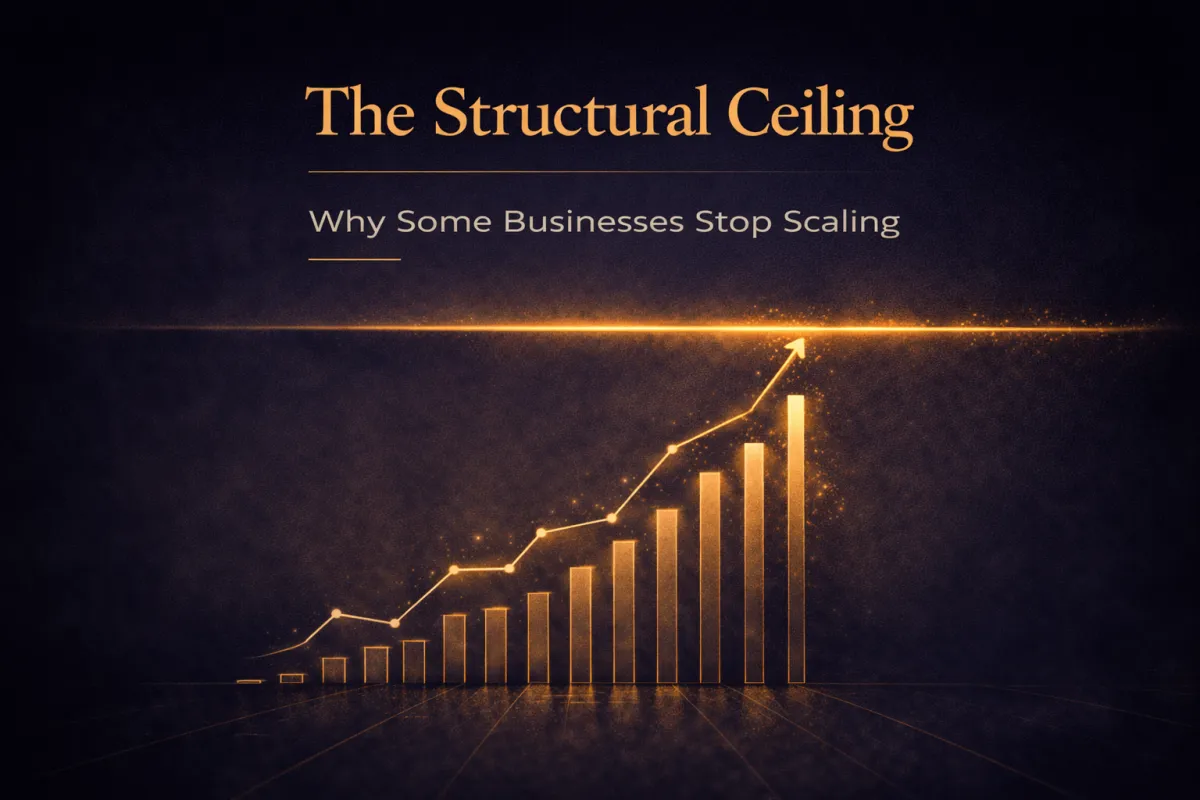
The company seems to encounter an invisible ceiling.
This ceiling is rarely caused by lack of effort.
More often, it reflects something deeper.
It reflects the structural design of the business itself.
What many founders encounter at this stage is not a growth problem.
It is a structural ceiling.
And structural ceilings cannot be solved through activity alone.
The Early Growth Phase
In the early life of a company, structure is rarely the primary driver of growth.
The founder is the architecture.
Decisions move quickly because they move through a single mind.
Customer relationships are often personal.
Sales conversations are led directly by the founder.
Operational decisions are made instinctively.
The company grows through responsiveness rather than design.
This stage rewards energy.
It rewards hustle.
It rewards closeness to customers.
Many founder-led companies reach their first several million in revenue this way.
The organization is small enough that complexity remains manageable.
Coordination happens informally.
Communication flows directly between individuals.
The founder remains deeply involved in most important activities.
In many ways, this early stage works precisely because the company is still simple.
The founder’s effort substitutes for structure.
Informal systems substitute for designed processes.
Personal oversight substitutes for organizational architecture.
For a time, this model works remarkably well.
The company grows.
The market responds.
Revenue expands.
But as scale increases, something important begins to change.
The Invisible Shift in Complexity
Growth quietly introduces a new dimension to the business.
Complexity.
More customers create more variability.
More employees create more coordination.
More services or products introduce more operational dependencies.
What once felt like straightforward work becomes increasingly interdependent.
Decisions begin affecting multiple parts of the organization simultaneously.
Communication that once occurred naturally now requires deliberate coordination.
Hiring adds capability, but it also adds layers.
Each additional person increases the number of relationships inside the organization.
Processes that once lived in the founder’s head must now be translated into shared understanding.
The company slowly transitions from a small group executing tasks to an organization managing systems.
Yet many founder-led companies reach this moment without intentionally designing those systems.
The structure of the business has simply evolved through accumulated decisions.
What once felt flexible now begins to feel fragile.
Small operational issues ripple across the organization.
Simple decisions require more discussion.
Problems appear in places that previously ran smoothly.
The organization begins to feel heavier.
Not because the team lacks talent.
But because the underlying architecture has not evolved alongside the company’s growth.
Why the $3M–$10M Stage Feels Different
Between roughly $3M and $10M in revenue, these pressures often become visible.
The company is no longer small.
But it has not yet developed the structural maturity of a larger organization.
The founder still plays a central role in many critical decisions.
Customers may still expect direct involvement from the founder.
Key relationships often remain founder-dependent.
Hiring begins to create coordination challenges.
New employees require context.
Roles become less clearly defined.
Teams may unknowingly duplicate work or pursue competing priorities.
Operational systems struggle to keep pace with demand.
Processes that once worked informally begin breaking down.
Margins often begin compressing during this stage.
Costs rise faster than operational efficiency improves.
Growth requires more effort than it once did.
Revenue increases no longer translate cleanly into profitability.
The founder’s calendar becomes increasingly saturated.
Strategic decisions compete with operational firefighting.
The organization becomes dependent on the founder’s availability.
At this stage, many founders begin feeling that the company is harder to run than it used to be.
They are not imagining it.
The company has entered a stage where structural design begins to matter far more than effort.
The Structural Nature of the Ceiling
Many founders respond to this stage with the instincts that built the company in the first place.
They work harder.
They pursue new sales initiatives.
They expand marketing efforts.
They hire additional staff.
These actions can temporarily push growth forward.
But they rarely eliminate the underlying friction.
Because the problem is not activity.
The problem is architecture.
The systems that once supported a small organization are now carrying a far larger operational load.
Decision pathways remain centralized.
Roles remain loosely defined.
Processes remain implicit.
Revenue growth begins amplifying structural weaknesses rather than resolving them.
The founder becomes the central coordination hub.
Information flows through them.
Decisions accumulate around them.
Bottlenecks appear in places that previously seemed manageable.
The business continues moving forward.
But every step forward requires increasing effort.
Eventually the founder realizes that simply pushing harder no longer changes the trajectory of the company.
The organization has reached the limits of its current structure.
It has reached its structural ceiling.
What Structurally Designed Companies Do Differently
Companies that successfully move beyond this stage often make a fundamental shift in how they think about growth.
They stop attempting to scale effort.
Instead, they begin designing architecture.
They recognize that sustainable growth requires systems capable of carrying greater complexity.
Leadership roles become intentionally defined.
Decision authority becomes clearer.
Operational processes become explicit.
Customer acquisition becomes systemized rather than founder-driven.
The organization begins shifting from personal dependency to structural capability.
Revenue generation becomes less reliant on individual relationships.
Operational workflows become repeatable.
Teams gain clarity about priorities and responsibilities.
The founder transitions from being the operational center of the company to becoming the architect of its structure.
This shift rarely occurs automatically.
It requires intentional design.
It requires examining how profit is produced.
How decisions flow.
How value is created inside the organization.
Companies that redesign their architecture during this stage often discover something surprising.
Growth begins to feel lighter again.
Margins stabilize.
Coordination improves.
The founder’s role becomes more strategic.
The organization becomes capable of operating without constant founder intervention.
In other words, the company becomes structurally scalable.
This shift represents the beginning of a new phase in the life of the business.
One where the organization is no longer powered primarily by founder effort.
It is powered by architecture.
Strategic Reflection
Many founder-led companies assume that scaling challenges reflect market conditions or operational execution.
Sometimes they do.
But very often the underlying issue is structural.
Growth introduces complexity.
Complexity exposes the architecture of the business.
If that architecture was never intentionally designed, the company eventually reaches its limits.
This moment does not mean the business has failed.
In many cases it means the company has reached the point where structural design becomes necessary.
The question is no longer how hard the founder is willing to work.
The question is whether the business itself has been designed to scale.
Businesses do not ultimately grow because of effort alone.
They grow when their structure allows them to carry greater complexity.
For many founders, the $3M–$10M stage is the moment when this distinction becomes visible.
What once worked through energy and instinct must now evolve into architecture.
And the future trajectory of the company is often determined by whether that architectural shift occurs. These structural drivers are part of the Profit Architecture Framework, a methodology used to design businesses that produce durable profit and scalable growth.
Schedule a 15-Minute Strategy Conversation.
A focused 15-minute discussion exploring the structural architecture of your business and the opportunities it may contain.
Beard Wise Consulting works with founder-led companies to design durable profit, scalable revenue, and transferable enterprise value.
Executive Overview of the Framework
If you would like a concise overview of the structural drivers behind the Profit Architecture framework, you may request the Executive Briefing.
The briefing outlines the 12 Core Profit Drivers used to evaluate structural profitability, scalability, and enterprise value.
Copyright © 2026 Beard Wise Consulting, LLC. All rights reserved
DISCLAIMER
The information contained on this website and the resources available for download through this website is not intended as, and shall not be understood or construed as, professional advice. While the employees and/or owners of the Company are professionals and the information provided on this Website relates to issues within the Company’s area of professionalism, the information contained on this Website is not a substitute for advice from a professional who is aware of the facts and circumstances of your individual situation. Nothing on this site, nor advice from our experts, shall constitute legal advice.