


Recent Thinking Insight
Why Many Founder-Led Companies Feel Harder to Run Over Time
As companies grow, founders often assume the business will gradually become easier to operate.
Instead, many discover that growth introduces new layers of complexity, coordination, and operational friction.
This insight explores why businesses frequently become harder to run as they scale — and why structural design ultimately determines whether growth simplifies operations or amplifies difficulty.
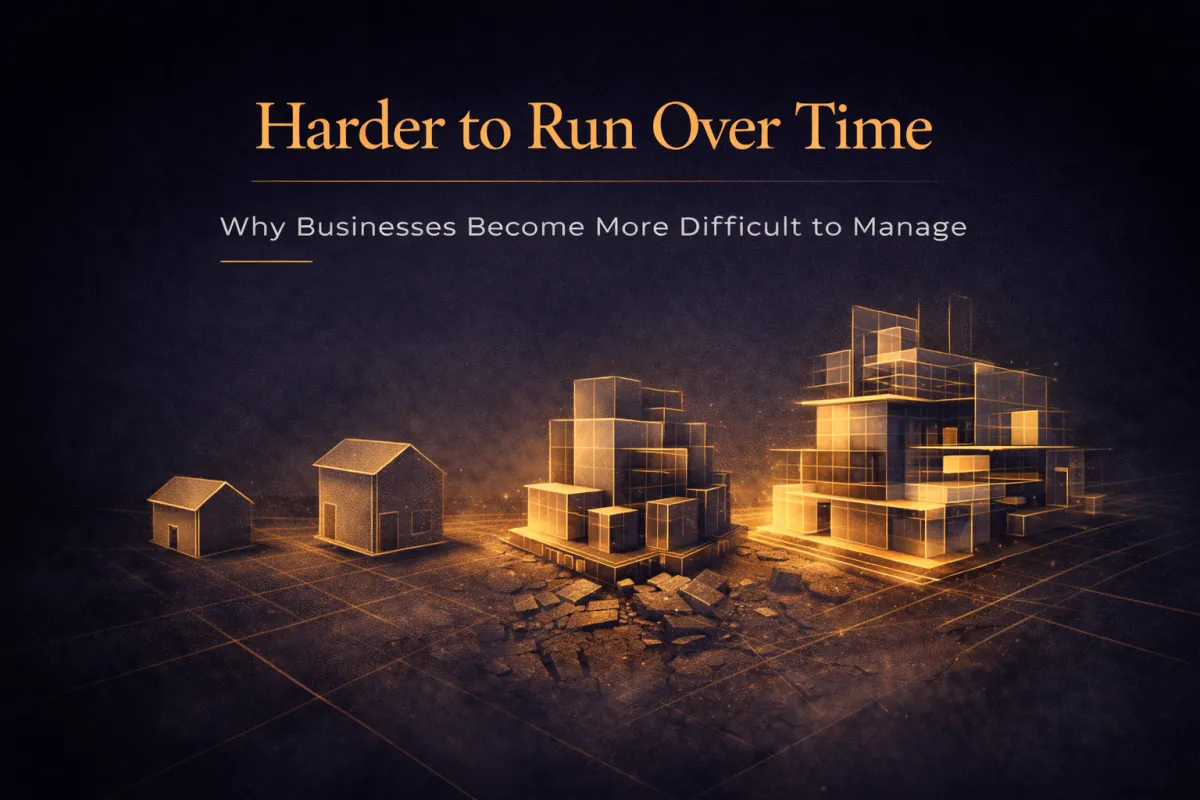
In the early stages of a business, growth often feels energizing.
Revenue increases.
Customers arrive.
The team expands.
Progress is visible and momentum is tangible.
Many founders assume that as the business becomes larger and more established, operations will gradually become easier to manage.
Experience should accumulate.
Systems should mature.
The company should begin to run more smoothly.
Yet many founders discover a very different reality.
As the business grows, the company often becomes harder to run.
Decisions require more coordination.
Communication becomes more complex.
Operational issues emerge in places that previously seemed straightforward.
What once felt simple begins to feel increasingly fragile.
From the outside, the company may appear successful.
Revenue has grown.
The team has expanded.
The organization has reached a scale that once seemed distant.
Yet internally, the founder often experiences something quite different.
The business feels heavier.
More attention is required.
Small problems seem capable of producing disproportionate disruption.
This experience is so common among founder-led companies that it is often assumed to be an unavoidable consequence of growth.
But in reality, the increasing difficulty of operating a business over time rarely comes from growth itself.
It comes from what growth reveals.
Growth does not merely expand a business.
Growth amplifies the underlying structure of the company.
Every assumption embedded in the organization becomes more visible.
Every operational weakness becomes more pronounced.
Every unclear process becomes a source of friction.
In the early stages of a business, structural weaknesses are often masked by effort.
A small team communicates informally.
Decisions happen quickly.
The founder personally resolves many operational issues.
Speed compensates for structural gaps.
But as the business grows, the volume of activity increases.
More customers.
More employees.
More moving parts across the organization.
The very mechanisms that once allowed the company to operate informally begin to strain under scale.
Communication that once happened naturally now requires coordination.
Decisions that once took minutes now involve multiple layers of discussion.
Processes that once existed implicitly now need to be clearly defined.
Without intentional design, the organization gradually accumulates operational friction.
Many founders initially respond to this friction in the only way they know how.
They work harder.
They hire more people.
They add new tools.
They introduce new initiatives designed to improve performance.
These actions often create short-term relief.
Yet they rarely address the underlying cause of the difficulty.
In some cases, they even make the problem worse.
Additional hiring increases coordination requirements.
New tools introduce new processes to manage.
More initiatives create more organizational activity.
The business grows busier, yet not necessarily more effective.
The underlying issue is rarely effort.
The underlying issue is architecture.
Every business operates according to a structural design, whether that design was created intentionally or emerged accidentally over time.
This design determines how decisions flow.
How work moves through the organization.
How revenue is produced.
And how complexity is managed.
When the architecture of a business is not intentionally designed, growth tends to magnify structural inefficiencies.
Processes overlap.
Responsibilities become unclear.
Decisions accumulate around the founder.
Operational complexity grows faster than organizational capability.
The company may continue to grow, but the experience of running it becomes progressively more demanding.
More coordination is required.
More oversight becomes necessary.
More founder involvement is needed to maintain momentum.
Over time, the founder becomes the stabilizing force holding the system together.
This dynamic often goes unnoticed for years.
From the outside, the company continues to expand.
From the inside, the operational burden gradually increases.
The founder may begin to feel that the business requires constant intervention.
Problems recur in different forms.
Progress requires more energy than it once did.
Running the company feels increasingly like managing complexity rather than building momentum.
Yet this outcome is not inevitable.
Some companies follow a very different trajectory.
As these businesses grow, the organization becomes clearer rather than more complicated.
Decisions move more efficiently through the company.
Teams operate with greater autonomy.
Operational friction gradually declines rather than increases.
Growth in these organizations does not amplify confusion.
It reinforces structure.
This difference is not a function of industry, talent, or ambition.
It is a function of design.
Businesses that become easier to run over time typically share one common characteristic.
Their underlying architecture has been intentionally designed.
Roles are clearly defined.
Revenue models are structurally coherent.
Operational processes align with the way value is actually created.
Decision authority flows through the organization in predictable ways.
When these elements are aligned, growth does not overwhelm the company.
It strengthens the system.
More customers reinforce existing processes rather than strain them.
Additional team members integrate into a structure designed to support scale.
Operational complexity grows more slowly than the organization’s ability to manage it.
The business becomes increasingly stable as it expands.
The founder’s role gradually shifts away from constant problem solving toward strategic leadership.
In these companies, scale produces clarity rather than confusion.
Growth reduces operational friction rather than increasing it.
The difference lies in the architecture of the business itself.
This structural perspective is central to the thinking behind Profit Architecture.
Profit Architecture approaches the business not as a collection of activities, but as a designed system.
A system in which revenue, operations, decision-making, and organizational design work together to produce predictable outcomes.
When this architecture is intentionally designed, the experience of running the business changes.
Growth becomes less destabilizing.
Operational complexity becomes more manageable.
The organization gains the structural capacity to support scale.
The founder no longer needs to compensate for structural weaknesses through effort alone.
The system itself begins to carry more of the operational load.
Over time, the company becomes easier to run rather than harder.
This shift is rarely achieved through incremental improvements.
It occurs when founders begin to view the business through a different lens.
Not simply as a growing organization, but as a system whose structure determines the results it produces.
From that perspective, the question changes.
The goal is no longer merely to grow the business.
The goal becomes to design a company whose architecture allows growth to strengthen the organization rather than strain it.
When the Profit Architecture Framework is in place, scale no longer introduces instability.
It introduces leverage.
And the experience of running the company begins to change in a profound way.
Schedule a 15-Minute Strategy Conversation.
A focused 15-minute discussion exploring the structural architecture of your business and the opportunities it may contain.
Beard Wise Consulting works with founder-led companies to design durable profit, scalable revenue, and transferable enterprise value.
Executive Overview of the Framework
If you would like a concise overview of the structural drivers behind the Profit Architecture framework, you may request the Executive Briefing.
The briefing outlines the 12 Core Profit Drivers used to evaluate structural profitability, scalability, and enterprise value.
Copyright © 2026 Beard Wise Consulting, LLC. All rights reserved
DISCLAIMER
The information contained on this website and the resources available for download through this website is not intended as, and shall not be understood or construed as, professional advice. While the employees and/or owners of the Company are professionals and the information provided on this Website relates to issues within the Company’s area of professionalism, the information contained on this Website is not a substitute for advice from a professional who is aware of the facts and circumstances of your individual situation. Nothing on this site, nor advice from our experts, shall constitute legal advice.